
The Human Connectome Project (HCP) was a five-year project launched in 2009 by sixteen institutes of the U.S. National Institutes of Health (NIH). The HCP pursued its research through two separate consortia. It began in July 2009 as the NIH’s first major challenge in the field of neuroscience. On September 15, 2010, the NIH announced funding for two consortia. A grant of $30 million over five years was awarded to a consortium led by Washington University in St. Louis and the University of Minnesota, in collaboration with the University of Oxford (FMRIB). Another grant of $8.5 million over three years was awarded to a consortium led by Harvard University, Massachusetts General Hospital, and the University of California, Los Angeles.
The objective of the HCP was to produce a comprehensive map of the network of brain connections, revealing facts about the structural and functional connectivity of different regions of the healthy human brain. The data generated by the project also facilitated existing research on brain disorders associated with autism, Alzheimer’s disease, schizophrenia, and dyslexia (reading and word-recognition disorders).
The project was officially closed and terminated on November 28, 2017.
Compare the fate of this terminated project with projects that remain permanently active and receive enormous budgets:
According to available reports, the final cost of the 2003 U.S. war in Iraq alone was approximately $2 trillion.
Including the wars launched after the September 11, 2001 attacks, the United States has spent nearly $8 trillion.
Even according to conservative and incomplete estimates, the 2003 Iraq War alone resulted in the deaths of more than 209,000 Iraqi civilians. Hundreds of thousands more suffered from the consequences of the war, including water shortages and various diseases. Some estimates place the total death toll at nearly one million. Another consequence of the post‑۹/۱۱ U.S. wars, particularly the war in Iraq, was the displacement and forced migration of millions of civilians. These wars forced 9.2 million Iraqis from their homes and, in total, displaced around 39 million people—many of whom, after reaching Western countries, faced deportation as undocumented and Illegal migrants. I will not even mention those who tragically drowned at sea while attempting these migrations.
In the current war between the United States and the Islamic Republic, U.S. Secretary of Defense(recently changed to war) Pete Hegseth announced that the cost of the war with Iran has already reached $37.5 billion.
Speaking before the U.S. Senate Appropriations Committee on Tuesday, July 22, 2026, regarding the White House request for an $87.6 billion supplemental appropriation, Mr. Hegseth stated that $67 billion of that request was intended to finance the war with Iran.
Consider that the U.S. expenditure on destroying the civil fabric of Iranian society—without even including the requested additional $67 billion—is approximately one thousand times greater than the budget that had been allocated to research on the diseases mentioned above. Not only was no additional funding provided to complete that project dedicated to protecting people’s health and lives, but the original project itself was officially terminated.
These statistics, and the comparison between their contradictory objectives, present us with a clear picture of the prevailing order in the world. This picture has clearly and explicitly gone beyond merely ‘interpreting’ the current state of the world and has placed the necessity of changing the world on the agenda of humanity.
‘Green socialism’ and pluralist socialism, which have embraced feminism and the rights of ethnic, national, and gender minorities, are nothing more than updated versions of the socialism of Proudhon and Bakunin—a new form of conservative socialism. There is no conceivable path other than overthrowing the forces that dominate humanity’s destiny by adopting theories that strike at the roots.
The question is: by what method and through what means can this change, and the necessity of overthrowing the powers that determine humanity’s fate, be realized?
Perhaps examining two major historical movements that posed such a transformation and such an overthrow of the existing order before humanity, together with an analysis of the reasons for their failure, can illuminate the path toward a fundamental transformation of the present order.
Marx explained thoroughly and profoundly the reasons for the failure of the Communards’ attempt at change. The Communards failed to smash the state machine and were therefore incapable of establishing an order fundamentally different from the existing one. As an example, Marx pointed to their failure to seize the Bank. He also gave a clear answer to another question: Why were the Communards unable to destroy the state machine and establish their own system of working-class leadership? Marx argued that it was because the Communards were followers of the socialism of Bakunin and Proudhon. Marx had already criticized Proudhon’s socialism in The Poverty of Philosophy from the standpoint that he later developed fully and systematically in Capital, where he documented the foundations of the wage-slavery system. In The Communist Manifesto, alongside working-class communism and socialism, Marx and Engels also referred to other forms of socialism—bourgeois, petty-bourgeois, reactionary, and conservative socialism. In the Paris Commune, the working class and the Communards defended one of these non-working-class forms of socialism.
In examining the causes of the defeat of the 1917 October Revolution, Mansoor Hekmat presents a socialist critique of the roots of that defeat in opposition to all democratic critiques.
The discussions of Worker-Communism contained in the ”Marxism and the Soviet Question Bulletin”[۱] and the seminars on the Foundations of Worker-Communism[2] are, in fact, a continuation of Marx’s line of criticism—derived from Capital and the Theses on Feuerbach—regarding the causes of the defeats of the Paris Commune and the October Revolution. Further more Mansour Hekmat is the author of deep insight in the essays and manifests such as:
- A Better World; Programme of the Worker-communist Party
- Left Nationalism and Working Class Communism
- Democracy: Interpretations and Realities
- Capital Rereading
- Party and Political Power
- Nation, Nationalism and the Program of Worker Communism
- Is the victory of communism possible in Iran?
In these original discussions, presented through a series of seminars and debates, it was explained that although Lenin’s line differed fundamentally from that of the Mensheviks with regard to the seizure of political power, Lenin’s line and method were not represented on questions of the economy and the socialist reconstruction of society after the conquest of power. the Bolsheviks and the Mensheviks proposed similar orientations. Consequently, in the absence of a genuine socialist alternative in the economic sphere, state control of the economy came to be regarded, in itself, as ‘socialism.’
Later, especially after the collapse of the Berlin Wall, the very idea of radical intervention in the process of social change came under attack, and the notion of merely ‘interpreting the world’ was substituted for the struggle for communist political power. Some, such as Slavoj Žižek, have even spoken of ‘socialist capitalism.’
Within the debates of Worker-Communism, a clear distinction is therefore drawn between Lenin’s method of changing the world and that the lernin´s method to change the world was not represented at the economic sphere.
I will not discuss here the roots of the defeat and collapse of the Worker-Communist Party of Iran. Nevertheless, it is possible to recognize which different interpretations of the foundations of Worker-Communism were defended by the dominant cadre layer and leadership of that party, and why they remained indifferent to its defeat and disintegration. Mansoor Hekmat explained this issue in his remarks at the last meeting of the Political Bureau before he passed away. Readers are referred to the transcript of those remarks through the link provided below:
In my view, on another level, a Marxist examination of the roots of the defeat and collapse of the Worker-Communist Party of Iran is no less important than the socialist analysis of the causes of the defeat of the Paris Commune and the October Revolution.
Although I have personally written several articles on this subject, I believe that what is needed is a collection of writings reviewing the history of communism in Iran since the 1979 Revolution, the evolution of this current of communism, the background to the formulation of the foundations of Worker-Communism in Sahand, the Union of Communist Militants, the Communist Party of Iran, and the Worker-Communist Party of Iran, together with the polemical discussions held in the plenums and various seminars of the latter two parties.
For my part, I am perhaps the only person who, with the generous assistance of Comrade Dennis Mir, has transcribed, typed, edited, digitized and published many of the discussions from those plenums and meetings. These debates, with their strongly polemical character, together with the theses, pamphlets, and seminar discussions that have been publicly published, would in effect constitute a bulletin similar to the Marxism and the Soviet Question´s Bulletin.
The following question will probably be raised: Why does the task of building a party based on the foundations of Worker-Communism weigh so heavily on my mind? Why can a broader party embracing the entire spectrum of the left not be proposed? Why can the reconstruction of the Worker-Communist Party on the basis of the existing human material in the various parties and circles—each of which claims to represent Worker-Communism, and some even add the suffix ‘Hekmatist’—not provide a shorter path? And why can methods not be adopted that are neither sectarian nor confined to a single interpretation of communism, or, in the terminology commonly used by the post–Berlin Wall left, that are non-single-party but pluralistic? Why, in that case, can such a broad and apparently non-sectarian coalition not be transformed into a framework for uniting the existing social movements that are identified with the left?
The answer to these likely questions becomes much clearer when we look more deeply at the entire spectrum of this left and at the actual practice of the components of such a possible—or promised—broad coalition.
I do not think that anyone who examines the history of splits and divisions among the various tendencies—from Rah-e Kargar and the Fadaiyan (Minority) to Komala and the different organizations calling themselves Worker-Communist—and who reads the hostile language they use against comrades who until yesterday stood beside them, can conclude that they are capable of existing together under a broader political roof.
Nor do I believe that a political current in which one side labels a former comrade as belonging to the ‘Axis of Resistance,’ while the other denounces its opponent as ‘pro-Israel’ and ‘pro-imperialist,’ or where, at the time of a split, one faction dismisses the other with the derogatory label ‘McCarthyist,’ could ever become the great common arena in which these forces would even exchange greetings with one another.
From this perspective, therefore, such a process within the existing left is impossible, or, in the most optimistic assessment, highly improbable.
For this reason, and also because of the type of communism that dominates these currents, even under the most optimistic assumptions any coalition or united action among them—even if the collapse of the Berlin Wall has not driven them entirely away from communism—would merely represent a marginal and isolated communism that are active at the weekend. This isolation from both society and the working class is already evident in each of these organizations and circles. Such a coalition could only survive for a limited period as an alliance based on a tendency toward socially isolated and fossilized sectarianism, until, at the next major turning point, it would once again fragment into even smaller and more politically insignificant groups, becoming still further alienated from society and the working class.
In my opinion, the foundation of a genuine social left and of a responsible, interventionist communism lies outside this entire spectrum and outside its existing human material. It is rooted instead in the depths of society.
Relying on this human material within society, in the context of the class struggle, while taking into account the two great workers’ revolutions of the nineteenth and twentieth centuries—the Paris Commune and the October Revolution—and building upon the theoretical and political achievements derived from the socialist and Marxist critique of the causes of their defeats, achievements that have been codified, documented, and made available to society, it is possible to build a genuine Worker-Communist Party.
The necessity for the existence of such a party is all the greater because of the critical political situation facing Iranian society.
Confronted with Iranian nationalism, the pro-Israeli and pro-American right, and even the possibility of an internal transformation of the Islamic Republic itself, such a party could serve as the anchor of a socialist transformation of Iranian society.
It could provide a perspective through which the socialist transformation of society can be pursued within the current political crisis, while preventing a repetition of the defeats of the October Revolution and the Paris Commune.
With the emergence and availability of such a party, Iranian society could witness a third workers’ revolution and successfully overcome the setbacks and failures of the previous two workers’ revolutions.
Iraj Farzad
۲۵ July 2026
iraj.farzad@gmail.com
[۱] Marxism and the Soviet Question – Bulletin of Opinions and Debates (Supplement to the “Towards Socialism” Publication).
۳ number of that Bulletin were published on March 1986; November 1986 and April 1988.
Some of the themes discussed in those numbers were:
-The Experience of Workers’ Revolution in the Soviet Union; Outline of a Socialist Critique
– Key issues in the analysis of the defeat of the proletariat in the Soviet Union
– Marginal notes on the recent Sweezy-Bettelheim debates
– Discussion at the seminar of the Communist Party of Iran on socialism in one country
– Back grounds for the deviation and failure of the proletarian revolution in the Soviet Union
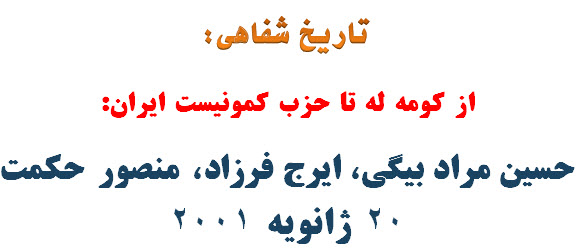
[۲] . ۳ semiras as such were held by Mansour Hekmat; the first one on March 1988 and the second and third on January 200 and January 2001 respective.
Posted in: ایرج فرزاد




» Leave a Reply